
Motley
Motley
Motley

Discover
Discover
Discover
Key Deliverables:
Key Deliverables:
→
→
→
Web application;
Web application;
→
→
→
Landing page;
Landing page;
→
→
→
Marketing & security pages;
Marketing & security pages;
→
→
→
Brand visual system.
Brand visual system.
Timeline: Aug 2025–May 2026
Timeline:
2025 → Ongoing
Timeline:
2025 → Ongoing
Role: Senior Product Designer
Role:
Lead Product Designer
Role:
Founding designer → Head of Design
(team of 3 designers)
Engagement:
Embedded, long-term
Engagement:
Embedded, long-term
Motley is an agent-native semantic layer platform that turns enterprise data warehouses into a governed, auditable source of truth for AI agents and recurring reporting workflows.
Motley is an agent-native semantic layer platform that turns enterprise data warehouses into a governed, auditable source of truth for AI agents and recurring reporting workflows.
The challenge was to combine reliable data, configurable charts and AI-written sections without making the product feel like a conventional slide editor.
The challenge was to combine reliable data, configurable charts and AI-written sections without making the product feel like a conventional slide editor.
4
4
Customer teams
Customer teams
~4h
~4h
Report preparation before
Report preparation before
~30m
~30m
Report preparation after
Report preparation after
Define
Define
Define
Motley sits between two crowded categories: legacy semantic layers like dbt MetricFlow and Cube — built for BI dashboards, not agents — and AI reporting tools that are fast but unreliable, returning different numbers on different runs.
Motley sits between two crowded categories: legacy semantic layers like dbt MetricFlow and Cube — built for BI dashboards, not agents — and AI reporting tools that are fast but unreliable, returning different numbers on different runs.
22 expert interviews
22 expert interviews
We spoke with data engineers, revenue operations leaders, and product teams already trying to bolt AI onto their analytics stack. The recurring pain wasn't speed — it was trust. Existing tools couldn't guarantee the same query returned the same answer twice, which made them unusable for anything customer-facing.
We spoke with data engineers, revenue operations leaders, and product teams already trying to bolt AI onto their analytics stack. The recurring pain wasn't speed — it was trust. Existing tools couldn't guarantee the same query returned the same answer twice, which made them unusable for anything customer-facing.
This led us to ask: "How might we let agents generate reports data teams trust enough to ship without manual review?"
This led us to ask: "How might we let agents generate reports data teams trust enough to ship without manual review?"
Personas
Personas
Maya, the Data Engineer (32, Senior Data Engineer):
Maya, the Data Engineer (32, Senior Data Engineer):
→
→
Owns the semantic layer for a fast-growing analytics team;
Owns the semantic layer for a fast-growing analytics team;
→
→
Tired of reconciling conflicting metric definitions across ad-hoc SQL;
Tired of reconciling conflicting metric definitions across ad-hoc SQL;
→
→
Needs auditability, versioning, and agent-ready metric exposure.
Needs auditability, versioning, and agent-ready metric exposure.
Daniel, the Customer Success Lead (38, Head of CS):
Daniel, the Customer Success Lead (38, Head of CS):
→
→
→
Prepares 30+ QBR presentations every quarter, mostly by hand;
Prepares 30+ QBR presentations every quarter, mostly by hand;
→
→
→
Wants automation that keeps the narrative intact, not generic AI slides;
Wants automation that keeps the narrative intact, not generic AI slides;
→
→
→
Needs consistent outputs and an audit trail when numbers get questioned.
Needs consistent outputs and an audit trail when numbers get questioned.
Sarah, the Embedded Builder (34, Product Manager):
Sarah, the Embedded Builder (34, Product Manager):
→
→
→
Shipping in-product reporting without a dedicated data platform team;
Shipping in-product reporting without a dedicated data platform team;
→
→
→
Needs governed primitives for queries and documents that work out of the box;
Needs governed primitives for queries and documents that work out of the box;
→
→
→
Needs embedable primitives and predictable output to ship fast.
Needs embedable primitives and predictable output to ship fast.
Problem Statement
Problem Statement
Agent Reliability
Agent Reliability
Agent Reliability
LLMs writing SQL against raw warehouse schemas hallucinated joins, redefined metrics silently, and returned different numbers on different runs — making them unusable for anything customer-facing.
LLMs writing SQL against raw warehouse schemas hallucinated joins, redefined metrics silently, and returned different numbers on different runs — making them unusable for anything customer-facing.
Fragmented Metric Definitions
Fragmented Metric Definitions
Fragmented Metric Definitions
Every team defined core metrics like ARR, active users, or churn slightly differently across dashboards, exports, and ad-hoc queries — and no one caught the drift until it surfaced in a board deck.
Every team defined core metrics like ARR, active users, or churn slightly differently across dashboards, exports, and ad-hoc queries — and no one caught the drift until it surfaced in a board deck.
Manual Recurring Reporting
Manual Recurring Reporting
Manual Recurring Reporting
QBRs, monthly check-ins, and pipeline reviews were rebuilt by hand every cycle — impossible to audit, easy to break, expensive to scale across customers.
QBRs, monthly check-ins, and pipeline reviews were rebuilt by hand every cycle — impossible to audit, easy to break, expensive to scale across customers.
In-Product Reporting Cost
In-Product Reporting Cost
In-Product Reporting Cost
Shipping reporting features inside SaaS products required staffing a full data platform team — most product teams couldn't justify it and shipped nothing instead.
Shipping reporting features inside SaaS products required staffing a full data platform team — most product teams couldn't justify it and shipped nothing instead.
How might we?
How might we?
→
→
→
HMW expose warehouse data to AI agents without losing metric integrity?
HMW expose warehouse data to AI agents without losing metric integrity?
→
→
→
HMW make recurring business reports as repeatable as code, not as fragile as slide decks?
HMW make recurring business reports as repeatable as code, not as fragile as slide decks?
→
→
→
HMW design a semantic layer that both data engineers and business users can actually read?
HMW design a semantic layer that both data engineers and business users can actually read?
→
→
→
HMW give every generated report a visible, governed audit trail?
HMW give every generated report a visible, governed audit trail?
→
→
→
HMW let product teams embed AI reporting in their own products in weeks, not quarters?
HMW let product teams embed AI reporting in their own products in weeks, not quarters?
Key metrics
Key metrics
To track success, we monitored:
To track success, we monitored:
→
→
→
Time to first governed query — Measuring how fast new teams reached production-ready output;
Time to first governed query — Measuring how fast new teams reached production-ready output;
→
→
→
Master reuse rate — How often a template was rerun vs. rebuilt from scratch;
Master reuse rate — How often a template was rerun vs. rebuilt from scratch;
→
→
→
Document acceptance rate — Share of generated reports shipped without manual editing;
Document acceptance rate — Share of generated reports shipped without manual editing;
→
→
→
Agent query success rate — Queries returning governed, validated answers on first attempt;
Agent query success rate — Queries returning governed, validated answers on first attempt;
→
→
→
Onboarding completion — New workspaces reaching their first published document.
Onboarding completion — New workspaces reaching their first published document.
Iterate
Iterate
Iterate
Our design process was driven by the need to balance technically demanding concepts — semantic models, MCP integrations, governed query resolution — with an experience approachable for business users generating recurring reports. The challenge wasn't designing for non-technical users — it was designing for technical users who couldn't afford to be wrong.
Our design process was driven by the need to balance technically demanding concepts — semantic models, MCP integrations, governed query resolution — with an experience approachable for business users generating recurring reports. The challenge wasn't designing for non-technical users — it was designing for technical users who couldn't afford to be wrong.
First Iteration:
First Iteration:
→
→
→
Started with a chat-first interface — a single prompt field, AI assembled the entire document end-to-end;
Started with a chat-first interface — a single prompt field, AI assembled the entire document end-to-end;
→
→
→
Treated the semantic layer as background infrastructure, surfaced only when needed;
Treated the semantic layer as background infrastructure, surfaced only when needed;
→
→
→
Validated that agents could produce coherent reports — but exposed friction below the surface.
Validated that agents could produce coherent reports — but exposed friction below the surface.
Second Iteration:
Second Iteration:
Testing revealed a consistent pattern: trust came from control, not magic.
Testing revealed a consistent pattern: trust came from control, not magic.
→
→
→
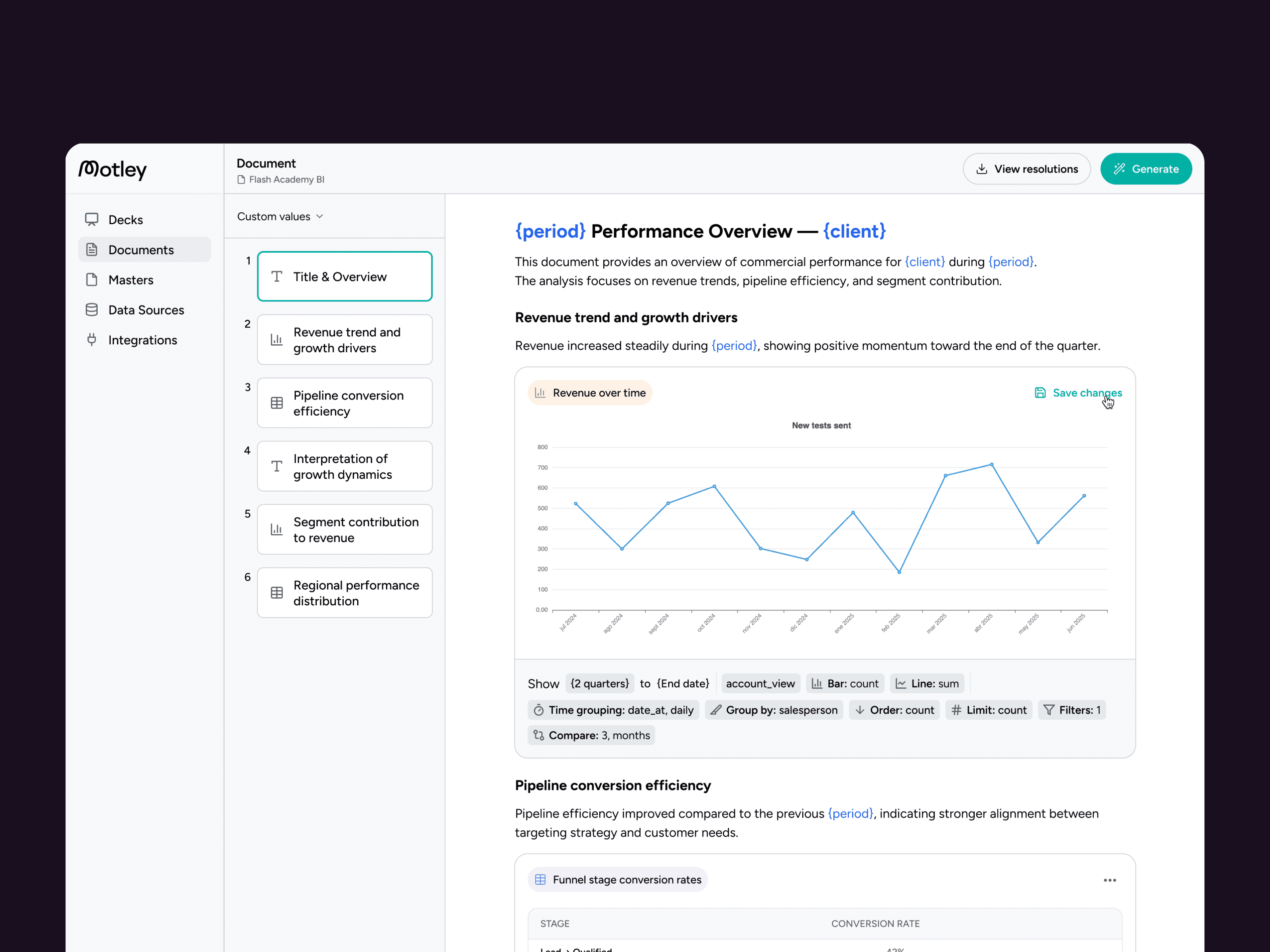
Replaced the prompt with a structured Master editor — typed blocks mapped cleanly to the semantic layer;
Replaced the prompt with a structured Master editor — typed blocks mapped cleanly to the semantic layer;
→
→
→
Surfaced data source selection upfront, with explicit toggles before generation begins;
Surfaced data source selection upfront, with explicit toggles before generation begins;
→
→
→
Introduced custom values ({customer_name}, {time_period}) so a Master could be reused deterministically;
Introduced custom values ({customer_name}, {time_period}) so a Master could be reused deterministically;
→
→
→
Added a persistent audit panel showing which queries resolved and where the agent fell back to raw data.
Added a persistent audit panel showing which queries resolved and where the agent fell back to raw data.
These iterations reframed the product from AI that writes reports to a governed system that lets agents write reports your data team can defend — the shift that unlocked enterprise adoption.
These iterations reframed the product from AI that writes reports to a governed system that lets agents write reports your data team can defend — the shift that unlocked enterprise adoption.

Design
Design
Design
The Design phase translated research into a coherent product surface — one operated confidently by data engineers writing semantic models and by CS leads generating QBRs the same week. Every decision was tested against one question: does this help the user trust what just got generated?
The Design phase translated research into a coherent product surface — one operated confidently by data engineers writing semantic models and by CS leads generating QBRs the same week. Every decision was tested against one question: does this help the user trust what just got generated?
Color Scheme & Visual Identity:
Color Scheme & Visual Identity:
→
→
→
A light, near-neutral base — Motley sits next to terminals and BI tools, and needed to read as an instrument, not a marketing surface;
A light, near-neutral base — Motley sits next to terminals and BI tools, and needed to read as an instrument, not a marketing surface;
→
→
→
Violet marks anything AI-touched; crimson (#FF0059) is a restrained secondary accent for emphasis;
Violet marks anything AI-touched; crimson (#FF0059) is a restrained secondary accent for emphasis;
→
→
→
Typography is built on Figtree — a geometric sans with the warmth a B2B data tool needs to avoid reading as cold infrastructure.
Typography is built on Figtree — a geometric sans with the warmth a B2B data tool needs to avoid reading as cold infrastructure.

User Experience & Engagement:
User Experience & Engagement:
→
→
→
A progressive disclosure model throughout — the underlying machinery is accessible, but never forced on users who don't need it;
A progressive disclosure model throughout — the underlying machinery is accessible, but never forced on users who don't need it;
→
→
→
Master and Document editing rebuilt around typed primitives — Title, Summary, Chart, Custom Values — each mapped to a governed query;
Master and Document editing rebuilt around typed primitives — Title, Summary, Chart, Custom Values — each mapped to a governed query;
→
→
→
A persistent audit trail turns "the AI made this" into a defensible chain of governed decisions.
A persistent audit trail turns "the AI made this" into a defensible chain of governed decisions.
Onboarding & Template Design:
Onboarding & Template Design:
→
→
→
Onboarding centers on one milestone — a connected data source resolving a governed query end-to-end, in under 30 minutes;
Onboarding centers on one milestone — a connected data source resolving a governed query end-to-end, in under 30 minutes;
→
→
→
MCP compatibility is surfaced directly in integration setup, with a live "connected" state for Claude, Cursor, and Codex;
MCP compatibility is surfaced directly in integration setup, with a live "connected" state for Claude, Cursor, and Codex;
→
→
→
Masters are clone-and-version primitives — every reusable QBR template can be duplicated and shared across workspaces.
Masters are clone-and-version primitives — every reusable QBR template can be duplicated and shared across workspaces.

Measure & Test
Measure & Test
Measure & Test
Data Analysis & Testing Approach:
Data Analysis & Testing Approach:
→
→
→
Instrumented every Master generation and query resolution via PostHog from day one;
Instrumented every Master generation and query resolution via PostHog from day one;
→
→
→
Documents generated from a pre-built Master were accepted without editing 3.2x more often than one-off prompts;
Documents generated from a pre-built Master were accepted without editing 3.2x more often than one-off prompts;
→
→
→
Users tolerated a slower governed query, but abandoned the workflow after a single hallucinated metric.
Users tolerated a slower governed query, but abandoned the workflow after a single hallucinated metric.

Enhancements Following SOC 2 Readiness:
Enhancements Following SOC 2 Readiness:
→
→
→
Per-workspace access controls, data residency signalling, and an audit log surfaced inside every Document;
Per-workspace access controls, data residency signalling, and an audit log surfaced inside every Document;
→
→
→
Security review questions that once triggered weeks of back-and-forth were increasingly answered by the interface itself.
Security review questions that once triggered weeks of back-and-forth were increasingly answered by the interface itself.
User Research & Iterative Refinements:
User Research & Iterative Refinements:
→
→
→
Early prototypes leaned playful — emoji, casual microcopy. Interviews revealed the audience expected an instrument, not a personality;
Early prototypes leaned playful — emoji, casual microcopy. Interviews revealed the audience expected an instrument, not a personality;
→
→
→
Microcopy rewritten in the voice of a senior data engineer — error states explain which query failed and why;
Microcopy rewritten in the voice of a senior data engineer — error states explain which query failed and why;
→
→
→
Structured, technical language increased first-Master completion by 22% among data engineers, with no drop among business users.
Structured, technical language increased first-Master completion by 22% among data engineers, with no drop among business users.

Expanded Integrations for Increased Credibility:
Expanded Integrations for Increased Credibility:
→
→
→
Named warehouse connectors (Snowflake, BigQuery, ClickHouse, Postgres, Databricks) shown as a first-class onboarding surface;
Named warehouse connectors (Snowflake, BigQuery, ClickHouse, Postgres, Databricks) shown as a first-class onboarding surface;
→
→
→
MCP-native compatibility with Claude, Cursor, and Codex reassures prospects Motley fits their existing agent stack;
MCP-native compatibility with Claude, Cursor, and Codex reassures prospects Motley fits their existing agent stack;
→
→
→
Open-source provenance — every governed query traces back to a SLayer definition, with a direct link to the repo.
Open-source provenance — every governed query traces back to a SLayer definition, with a direct link to the repo.
The Measure & Test phase shifted Motley from a product that produced reports to a product whose reports could be defended on a customer call. The metrics that mattered: acceptance rate, first-run accuracy, and time to enterprise trust.
The Measure & Test phase shifted Motley from a product that produced reports to a product whose reports could be defended on a customer call. The metrics that mattered: acceptance rate, first-run accuracy, and time to enterprise trust.

Impact
Impact
Impact
Motley was built from zero — no legacy product, no prior interface, no existing users to migrate.
Motley was built from zero — no legacy product, no prior interface, no existing users to migrate.
Time to First Governed Query
Time to First Governed Query
New users reach a working governed query in under 30 minutes from sign-up, driven by surfacing Data Sources first and structuring the Master editor around typed blocks rather than free-form prompts.
New users reach a working governed query in under 30 minutes from sign-up, driven by surfacing Data Sources first and structuring the Master editor around typed blocks rather than free-form prompts.
Document Acceptance Rate
Document Acceptance Rate
87% of generated documents ship to customers without manual editing — the metric the team optimised above all others, since a report is only valuable if it can be sent without a human review pass. The audit panel was the single largest contributor, confirmed in qualitative interviews.
87% of generated documents ship to customers without manual editing — the metric the team optimised above all others, since a report is only valuable if it can be sent without a human review pass. The audit panel was the single largest contributor, confirmed in qualitative interviews.
Trust Signals in Sales & Support
Trust Signals in Sales & Support
Security review cycles close in the same week for design partners, attributed to surfacing audit trail and access controls as first-class UI. Support tickets about "the AI gave the wrong number" stay near zero — users self-diagnose via the audit panel.
Security review cycles close in the same week for design partners, attributed to surfacing audit trail and access controls as first-class UI. Support tickets about "the AI gave the wrong number" stay near zero — users self-diagnose via the audit panel.
The reframing matters more than any single number. Motley isn't described as another AI reporting tool, but as the layer agents query when the answer has to be defensible — a position the design earned by treating governance, audit, and metric integrity as primary UI, not secondary copy.
The reframing matters more than any single number. Motley isn't described as another AI reporting tool, but as the layer agents query when the answer has to be defensible — a position the design earned by treating governance, audit, and metric integrity as primary UI, not secondary copy.
Copyright © 2026 Monochromatic Ltd. All rights reserved.
Workhub, 77 Lower Camden Street, Dublin, D02 XE80, Ireland
Copyright © 2026 Monochromatic Ltd. All rights reserved.
Workhub, 77 Lower Camden Street, Dublin, D02 XE80, Ireland
Copyright © 2026 Monochromatic Ltd. All rights reserved.
Workhub, 77 Lower Camden Street, Dublin, D02 XE80, Ireland